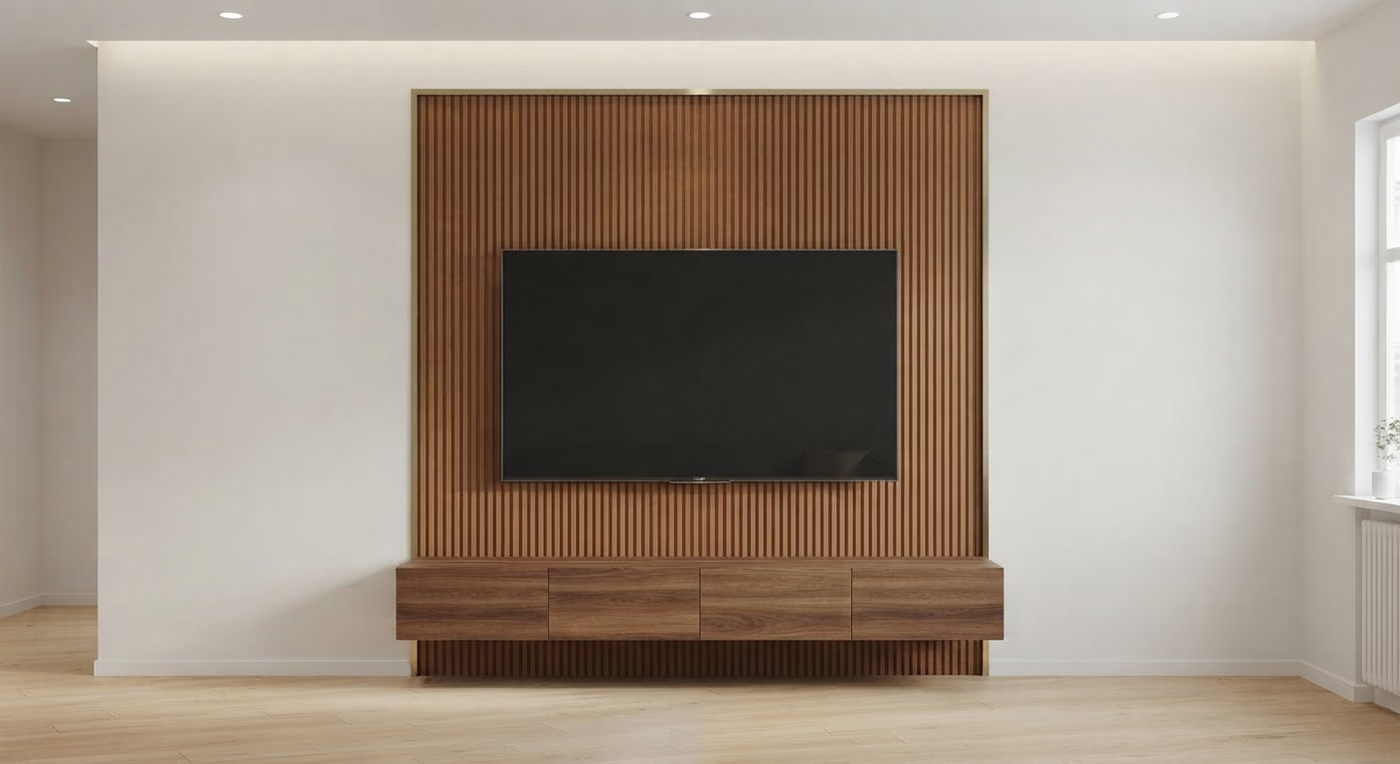
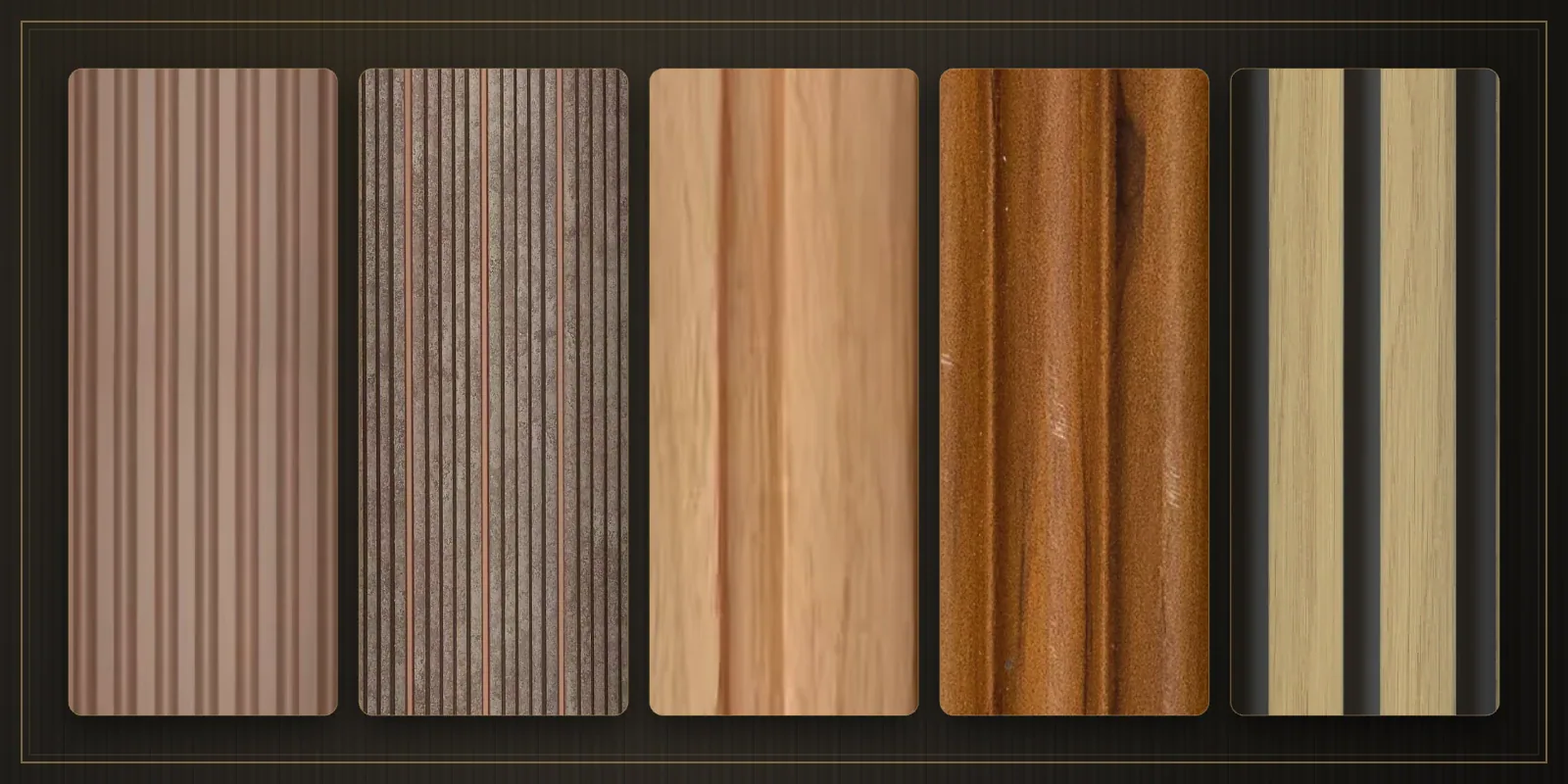
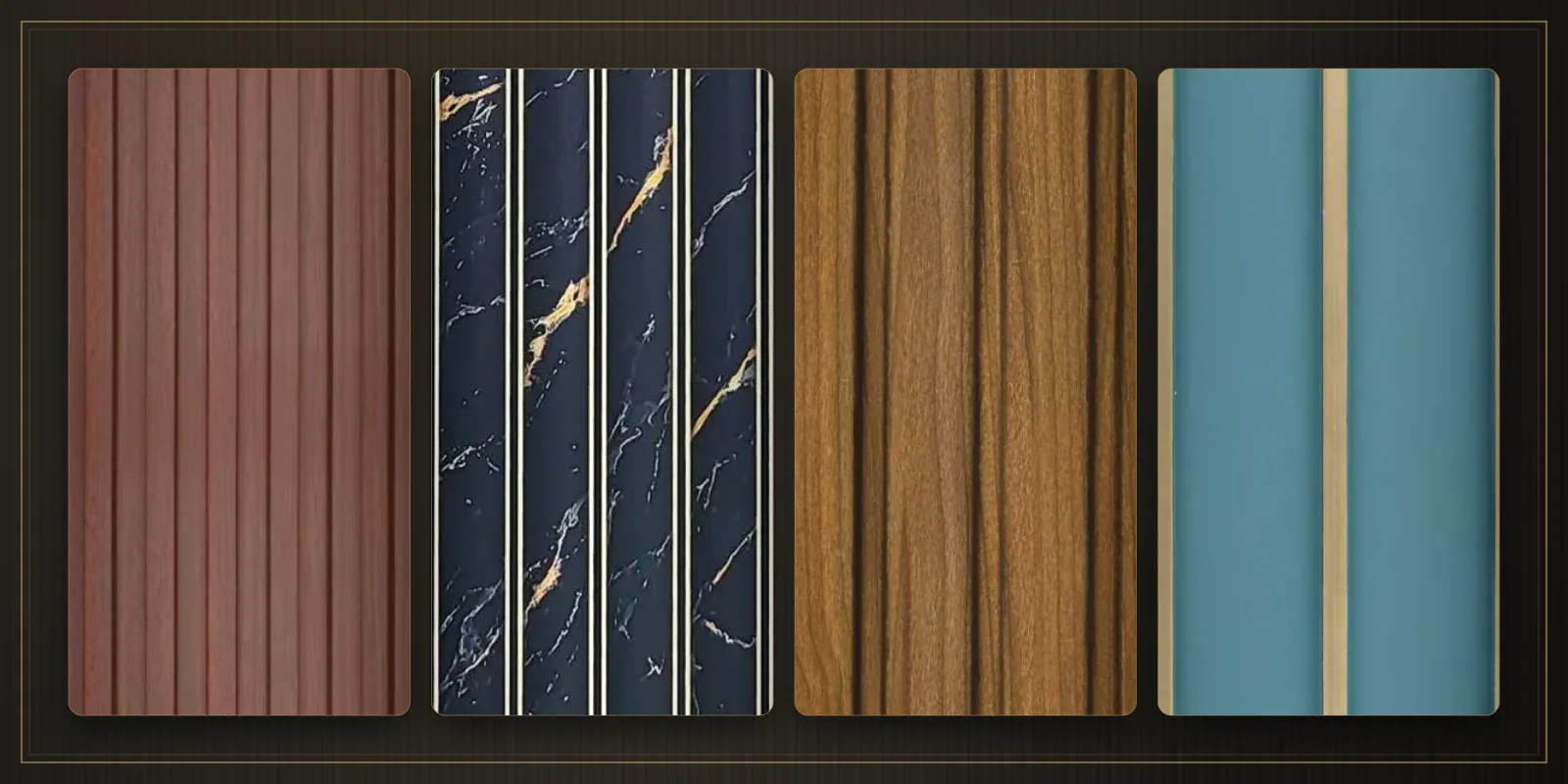
WPC, charcoal and PVC panels can look almost identical in a product photo: vertical flutes, a wood or marble finish, a neat feature wall. On the wall, they behave very differently. They differ in weight, how they handle moisture and sun, how deep the profiles go, how real the finish looks up close, and what they cost per square foot.
This guide compares all three on the points that actually decide a purchase, with real prices from our Bangalore showroom, so you can pick the right panel for each room instead of the cheapest or the most expensive.
Quick answer: choose WPC for strength, deep fluted profiles and areas with some moisture; choose charcoal panels for the widest range of premium finishes (marble, fabric, gold inlay, chevron) on interior feature walls; choose PVC only for tight budgets, wet zones or temporary and rental work. Our WPC panels cost about ₹104 to ₹255 per sq ft and charcoal panels about ₹188 to ₹237 per sq ft.
What each material is
WPC (wood plastic composite)
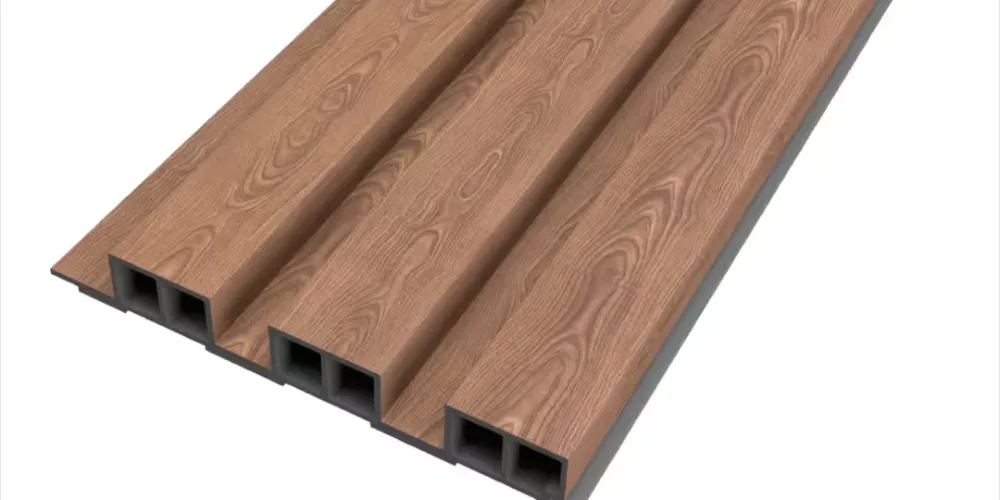
WPC panels are made from wood fibre blended with thermoplastic polymer and extruded into solid or hollow profiles. They are dense and strong, which is why they can be made in deep shapes like 25 to 26 mm box fins. WPC resists moisture and termites. Brands we stock include Century Prime and Select and E3 Clads Mabel.
Charcoal panels
Charcoal panels are a polymer composite made with charcoal powder (often sold as bamboo charcoal panels), finished with a printed or textured surface film. They are lighter than WPC, typically 10 to 12 mm thick, and come in by far the widest range of finishes: wood, stone, marble, fabric weaves, metallic gold or rose-gold inlay lines and chevron patterns. They are made for interior walls. We stock charcoal panels from E3 Clads, Advance and Urodecor.
PVC panels
PVC panels are made from rigid vinyl, usually hollow or thin-walled. They are the lightest and cheapest of the three and fully waterproof, but most fluted PVC panels have shallower profiles, a flatter printed finish and less rigidity, so they can look and feel less premium on a large feature wall.
WPC vs charcoal vs PVC: side-by-side comparison
| Feature | WPC | Charcoal | PVC |
|---|---|---|---|
| Price per sq ft (material) | ₹104–255 (our range) | ₹188–237 (our range) | ₹50–350 (market range) |
| Weight | Heaviest, dense | Light | Lightest |
| Typical thickness | 8–26 mm | 10–12 mm | Usually thin or hollow |
| Profile depth | Shallow to very deep fins | Shallow to medium flutes | Mostly shallow |
| Finishes | Wood grain, solid colours | Widest: wood, marble, fabric, gold inlay, chevron | Printed wood and stone |
| Moisture | Very good | Good indoors; keep away from direct water | Fully waterproof |
| Termite resistance | Yes | Yes | Yes |
| Best for | Full walls, TV walls, deep shadow looks | Feature walls, luxury and statement finishes | Budget, wet zones, rentals |
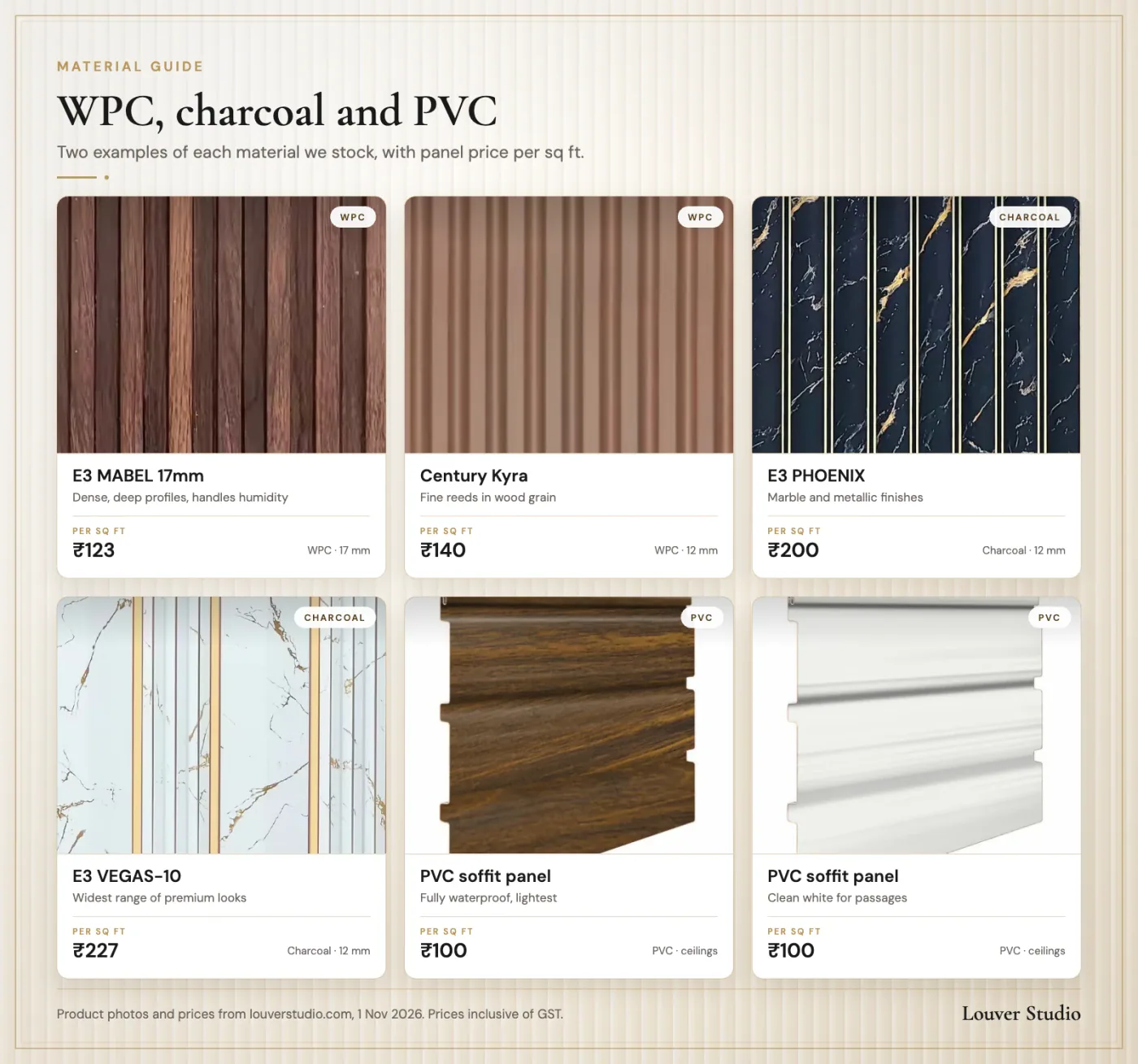
Our WPC and charcoal prices are per panel as on 31st October 2026, worked out per sq ft from each panel's coverage. The PVC figure is a typical Indian market range for material only, as reported by Design Cafe in February 2026; we do not stock fluted PVC wall panels.
Price per sq ft: real examples
- E3 Mabel 9 mm (WPC): ₹550 per panel, about ₹104 per sq ft. The most affordable panel we stock.
- Century Select Kyra (WPC): ₹699, about ₹140 per sq ft.
- Century Prime Troika (WPC): ₹1,150, about ₹189 per sq ft.
- Century Prime Deuce (WPC, 26 mm): ₹1,499, about ₹247 per sq ft.
- Advance charcoal (9.5 ft x 5 in): ₹750, about ₹188 per sq ft.
- E3 Vol-III charcoal (8 ft x 5 in): ₹750, about ₹225 per sq ft.
- E3 Phoenix charcoal (12 in wide): ₹1,899, about ₹200 per sq ft.
For a 10 ft wide, 9.5 ft high wall (with one spare panel), that works out to about ₹10,450 in Mabel 9 mm, ₹18,750 in Advance charcoal, ₹19,550 in Century Troika and ₹25,483 in Century Deuce. Fixing them to a flat wall adds about ₹8,500 more: roughly 12 tubes of silicone adhesive at ₹230 (one tube covers about 8 sq ft) and labour at about ₹60 per sq ft. See every range in our WPC louvers price list, or use the louver calculator for your wall.
Moisture, sun and termites
All three resist termites, which is a big reason they have replaced solid wood and MDF panelling in Indian homes. The differences show up with water and sunlight:
- Kitchens and bathrooms: WPC and PVC handle humidity best. Charcoal panels are fine in a dry part of a bathroom or as a kitchen feature wall, but keep them away from direct splashes and shower spray.
- Monsoon and damp walls: fix any seepage first. A panel will hide a damp wall, but not cure it.
- Direct sun: none of these panels are meant for full sun, which can fade printed finishes over time. They are made for interior walls.
Weight and installation
On a flat, dry wall, all three are usually fixed straight to the wall with silicone adhesive. One ₹230 tube covers about 8 sq ft, and labour in Bangalore is about ₹60 per sq ft, so adhesive and labour together add roughly ₹89 per sq ft. If the wall is uneven or damp, or you want to run cables behind the panels, a batten or plywood frame goes up first, which adds cost. Whatever the panel, a TV or heavy shelf must be fixed into the wall or a plywood backing, never to the panel alone; see our guide on mounting a TV on a louver wall.
Which one should you choose? Room by room
| Room or use | Best choice | Why |
|---|---|---|
| TV wall, large living room | WPC (deep profiles) | Strong shadows and a solid feel |
| Bedroom headboard wall | Charcoal or WPC | Calm finishes; fabric and wood looks |
| Luxury or statement wall | Charcoal | Marble, gold inlay, chevron and fabric finishes |
| Kitchen feature wall | WPC | Handles humidity and wipes clean |
| Bathroom (dry zone) | WPC or PVC | Moisture resistant; keep charcoal away from spray |
| Small budget or rental | PVC or E3 Mabel 9 mm | Lowest cost per sq ft |
For design ideas using these panels, see 10 TV unit design ideas, bedroom wall panel ideas and our guide to louver panel shapes.
Frequently Asked Questions
Neither is better everywhere. WPC is stronger, handles moisture better and comes in deep profiles, so it suits full walls and TV walls. Charcoal panels are lighter and have the widest range of premium finishes, so they suit feature and statement walls indoors.
Usually yes. PVC wall panels typically cost about ₹50 to ₹350 per sq ft for material, while our WPC panels cost about ₹104 to ₹255 per sq ft. PVC is fully waterproof but often looks and feels less premium on a large feature wall.
They resist humidity well indoors and wipe clean, but they should not be used where they get direct water, such as inside a shower or right behind a sink. Use WPC or PVC there.
PVC is the lightest, then charcoal. WPC is the heaviest because it is dense, which is also why it can be made in deep, strong profiles.
No. WPC, charcoal and PVC panels are all termite resistant, unlike solid wood or MDF panelling.
See and touch all three
The fastest way to choose is to see the panels side by side. Visit our Dommasandra showroom on Varthur Main Road, open Monday to Saturday, 10am to 6pm, to compare full-size WPC and charcoal panels, or browse WPC louvers and charcoal panels online. Send us your wall size and room, or book a free consultation, and we will recommend the right material and an exact panel count.
Back to Blog